
Alachua County Court Records After a Jail Arrest
When someone is arrested and booked into the Alachua County Jail, the booking is a law-enforcement event. The court record begins later, when the State Attorney for the Eighth Judicial Circuit reviews the charges and decides what to file. The prosecutor can file by sworn complaint, notice to appear, or civil citation, and the office generally makes that decision within 30 days of receiving the charges. The case that opens at the clerk is the court record that tracks the arrest from charge through disposition.
The booking side and the court side are two different records. For the jail roster and booking detail, the jail inmate records page covers custody status, bond, and housing, and booking photos appear on the jail mugshots page. The court record, by contrast, holds the charges the prosecutor actually filed, the docket, and the outcome, which is why an arrest charge and a court charge are not always the same.
How to Find Alachua County Court Records After an Arrest
Court records after an arrest are searched through the Alachua County Clerk of Court. The clerk provides internet access to the index of county court cases, and a direct portal sits behind a captcha sign-in. Online document availability begins in December 2005 for criminal cases, with older closed criminal records sometimes available only at the courthouse Records Department at 201 E. University Avenue. The booking and custody side stays on the jail roster, while the charge and case side lives in the clerk index.
- Open the Alachua Clerk court-record portal and clear the captcha sign-in.
- Search by defendant last name and first name, or by case number without the county-code prefix.
- Open the case to read the charge list and the docket of filed documents.
- Check each charge's statute, level, and current status.
There is no single statewide Florida portal for Alachua criminal court cases, so the local clerk is the source. For records that are not online, the clerk takes requests by email to osr@alachuaclerk.org or by mail to the Public Records Custodian at 201 E University Ave, Gainesville FL 32601, with court-record copies listed at $1 per page. The clerk's court-records guidance is shown below.
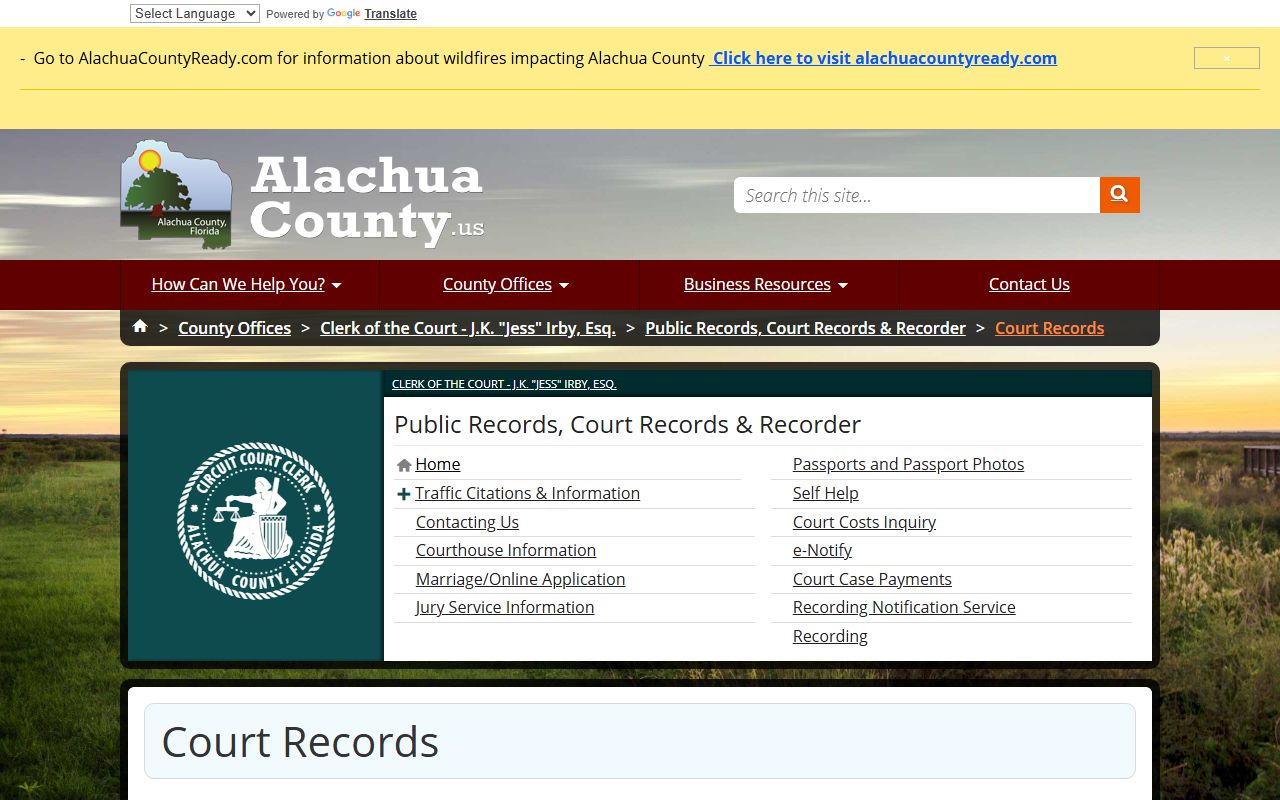
That page sets out the date ranges, search limits, and courthouse fallback for any court record an arrest produces.
How Charges Get Filed After an Arrest: Complaint, Information, and Indictment
The arrest is step one, but the charge record begins when the prosecutor files a charging document. Officers submit the arrest charges, the State Attorney reviews them for legal sufficiency, and a case opens only if the review supports it. If the charges are legally insufficient, the case is dismissed. If they are sufficient and diversion-eligible, the person is notified about diversion. If they are sufficient and not diversion-eligible, a court date is set. Three document types do most of the work.
| Complaint | Information | Indictment | |
|---|---|---|---|
| Filed By | Officer or prosecutor | State Attorney | Grand jury |
| Common For | Misdemeanors | Most felonies | The most serious felonies |
| Effect | Brings the accusation | Opens the court case | Opens the court case |
The State Attorney's office processes roughly 20,000 criminal cases a year, with a county court division handling misdemeanors and a felony division handling felony cases.
How the State Attorney Reviews Charges After an Arrest
The charging decision belongs to the State Attorney for the Eighth Judicial Circuit, currently Brian S. Kramer, whose office covers Alachua, Baker, Bradford, Gilchrist, Levy, and Union counties. The office reviews each arrest for legal sufficiency before a court record opens. A county court division led by Stephanie Klugh handles misdemeanors and criminal traffic, and a felony division led by Glenn Bryan handles felony cases. The decision is generally made within 30 days of receiving the charges from the arresting officer.
That review is the reason a court record can look different from the arrest. The prosecutor can decline a legally insufficient case, route an eligible person to diversion, or set a court date, and each path changes what appears in the clerk's file. The State Attorney prosecution team that handles those decisions is shown below.
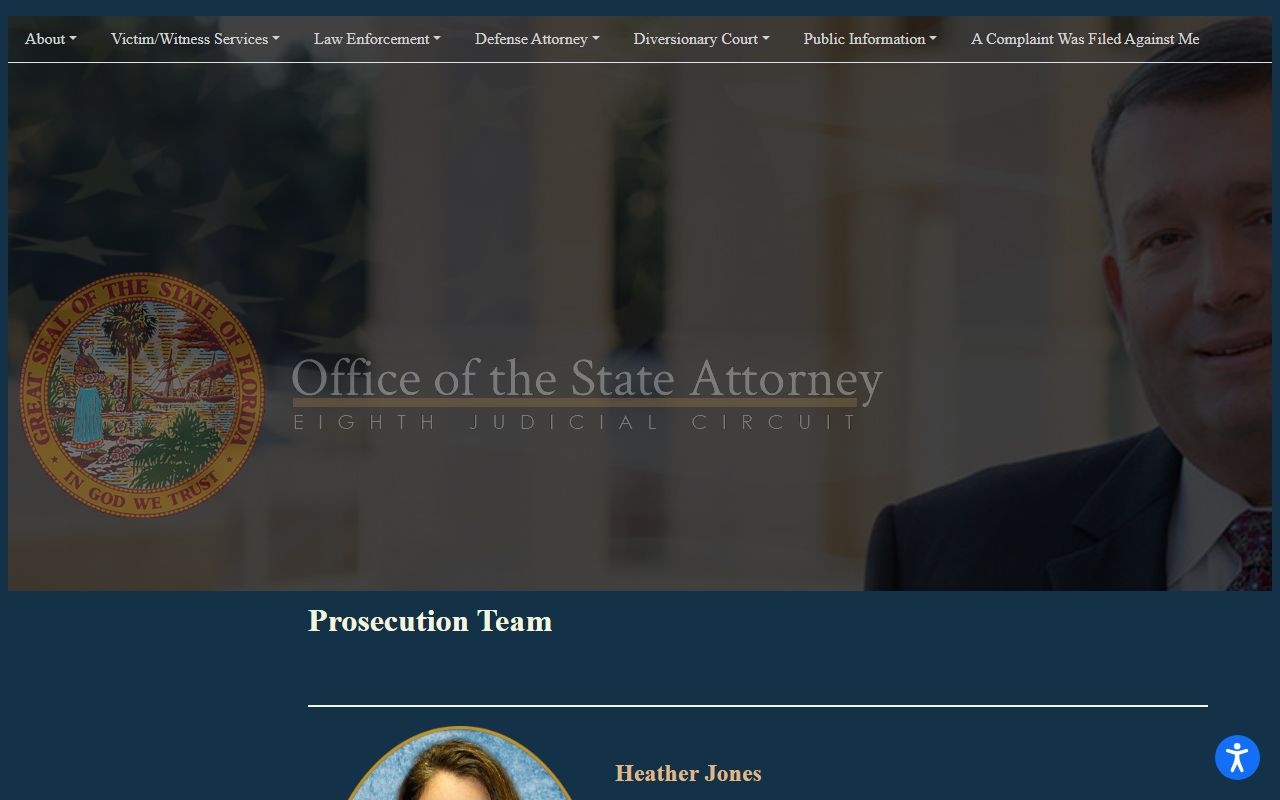
The division structure on that page shows how a misdemeanor arrest and a felony arrest follow different prosecutors toward the court record.
Case numbers in the clerk index also follow set formats, and older numbers were converted. An old style like 1997-1234-CA now reads 1997CA1234, family matters formerly filed as CA may now appear as DR, probate and guardianship cases use CP, mental-health cases use MH, and county court and small-claims matters use CC or SC. Knowing the format helps when a name search returns too many results.
Charge Status and What It Means
Charges shift as a case moves. A prosecutor can amend, reduce, add, or drop counts, and the booking charges on the jail roster can differ from what is finally filed in court. That gap is normal and is the reason the court record, not the arrest record, is the authoritative source for what a person is actually facing. The terms below show up often in a case file.
| Status | What It Means |
|---|---|
| Pending | The case is open and moving through the court; no final outcome yet. |
| Amended / Reduced | The prosecutor changed a charge, often to a lesser offense. |
| Dismissed | The charge was dropped and the court took no conviction. |
| Nolle Prosequi | The prosecutor formally declined to pursue the charge. |
Note: a charge listed at booking is an accusation, so always read the current court status before assuming what a case involves.
Bond and Release After an Arrest
Bond is set around first appearance, the hearing each arrestee gets within 24 hours by closed-circuit television from the jail. Florida still uses commercial bail bonding, so a person can post a cash bond or use a certified surety agency registered in Alachua County. Bonds are posted at the jail lobby window between 6:00 a.m. and 11:00 p.m., with an after-hours window to the left of the front entrance. A hold or no-bond status can keep a person in custody even after a payment.
| Bond Type | How It Works |
|---|---|
| Cash Bond | Cash, money order, or cashier's check payable to the Clerk of the Court, with the inmate's full name and MNI number. |
| Surety Bond | Written by a certified bonding agency registered with the Alachua County Clerk and the sheriff. |
| Release on Recognizance | A court release order that does not require a posted surety bond. |
| No-Bond Hold | A warrant, detainer, or court order that blocks release even if money is paid. |
The sheriff lists several reasons release can be delayed after an order, including document errors, active warrants, other-jurisdiction detainers, electronic monitoring, and Nebbia hearings, which test the source of bond money.
Warrants That Lead to an Arrest
An outstanding warrant is a common path to a booking. The sheriff's Warrants Bureau, reached at (352) 367-4138, encourages anyone who believes they have an active warrant to turn themselves in around the clock at the jail. The bureau also serves adult criminal summonses, which are orders to appear in court rather than arrest orders, picked up at the lobby at 2621 SE Hawthorne Road on weekdays from 8:00 a.m. to 3:30 p.m. If a summons is ignored, it is returned to the clerk and an arrest capias issues. There is no official public online warrant search for ordinary county warrants, so the warrant phone line and a public-records request are the fallback.
Charges vs. Convictions
Being arrested and charged is not the same as being convicted. A charge is an accusation that rests on probable cause. A conviction requires a verdict or a plea and a much higher standard of proof. Both can appear in the public court record, but they sit at very different stages.
| Charge | Conviction | |
|---|---|---|
| Stage | Accusation | Verdict or plea |
| Burden of Proof | Probable cause | Beyond a reasonable doubt |
| Public Record | Yes | Yes |
Sealed vs. Expunged Arrest Records
Florida lets some people clear a record after a dismissal or an eligible disposition. Sealing hides a record from public view while leaving limited official access, and expunction goes further, treating the record as though it never existed for most purposes. The two are governed by separate statutes, and neither erases every copy that ever reached a third party.
| Sealed | Expunged | |
|---|---|---|
| Visibility | Hidden from the public | Destroyed or treated as never existing |
| Law Enforcement | Limited access remains | Very limited access |
| Governing Law | Florida Statutes § 943.059 | Florida Statutes § 943.0585 |
Background Check Considerations
There is a difference between a casual public-records lookup and a formal background check. A regulated background check used for hiring, housing, credit, or insurance must follow the federal Fair Credit Reporting Act, which sets rules a consumer reporting agency has to meet. A simple search of court records after an arrest is not the same thing and carries no such standing.
Important: This site is not a consumer reporting agency under the FCRA, and nothing here may be used for credit, employment, insurance, or tenant screening decisions.
Restricted Court Records After an Arrest in Alachua County
Not every record tied to an arrest is open. Florida's public-records law carries exemptions for active criminal investigative information and for certain victim and personnel data. Juvenile cases follow separate confidentiality rules, sealed and expunged records drop out of public view, and dismissed charges can be withheld in some situations. The court file is the authoritative source, but a missing item often reflects one of these limits rather than an error, and a public-records request to the clerk is the way to test what can be released.