
Alachua Regional Juvenile Detention Center Overview
The Florida Department of Juvenile Justice operates this center as a hardware-secure detention facility, separate from the adult county jail system. It holds youth detained pending adjudication, disposition, or placement in a commitment program. The detention center serves a wide region, with counties served including Alachua, Baker, Bradford, Columbia, Dixie, Gilchrist, Hamilton, Lafayette, Levy, Suwannee, and Union. Because the population is juvenile, the rules for custody, records, and visitation are different from those for adults at the county jail.
Juvenile justice in Florida treats detention as short-term and case-driven. The state reports an average length of stay in secure detention of roughly 11 days, so the population here turns over quickly compared with an adult jail.
Capacity and Who Is Held
The state lists this as a 45-bed hardware-secure facility. The youth held here are detained, not sentenced as adults, and they remain only while a court decides the next step in the case. Services on site include education, mental health, substance abuse, and health care, with medical and mental-health services contracted and education funded through the Department of Education by local school districts.
A typical day includes hygiene, meals, school, structured physical and educational activities, and court appearances as scheduled.
How to Look Up a Youth at the Detention Center
There is no public online roster for juvenile detention the way there is for the adult county jail. Florida law treats juvenile custody and case information as confidential, so a youth in detention does not appear on a searchable public list. To reach the right people, contact the Florida Department of Juvenile Justice or the facility directly, or work through the family and the youth's attorney. The adult county jail roster does not cover juveniles.
- Do not expect a public juvenile roster; juvenile records are confidential under state law.
- Contact the Florida Department of Juvenile Justice or the facility for case-appropriate information.
- Work through the youth's parent or legal guardian and the assigned attorney.
- For an adult held nearby, use the county jail roster or the state corrections locator instead.
The state facility page for the center is shown below.
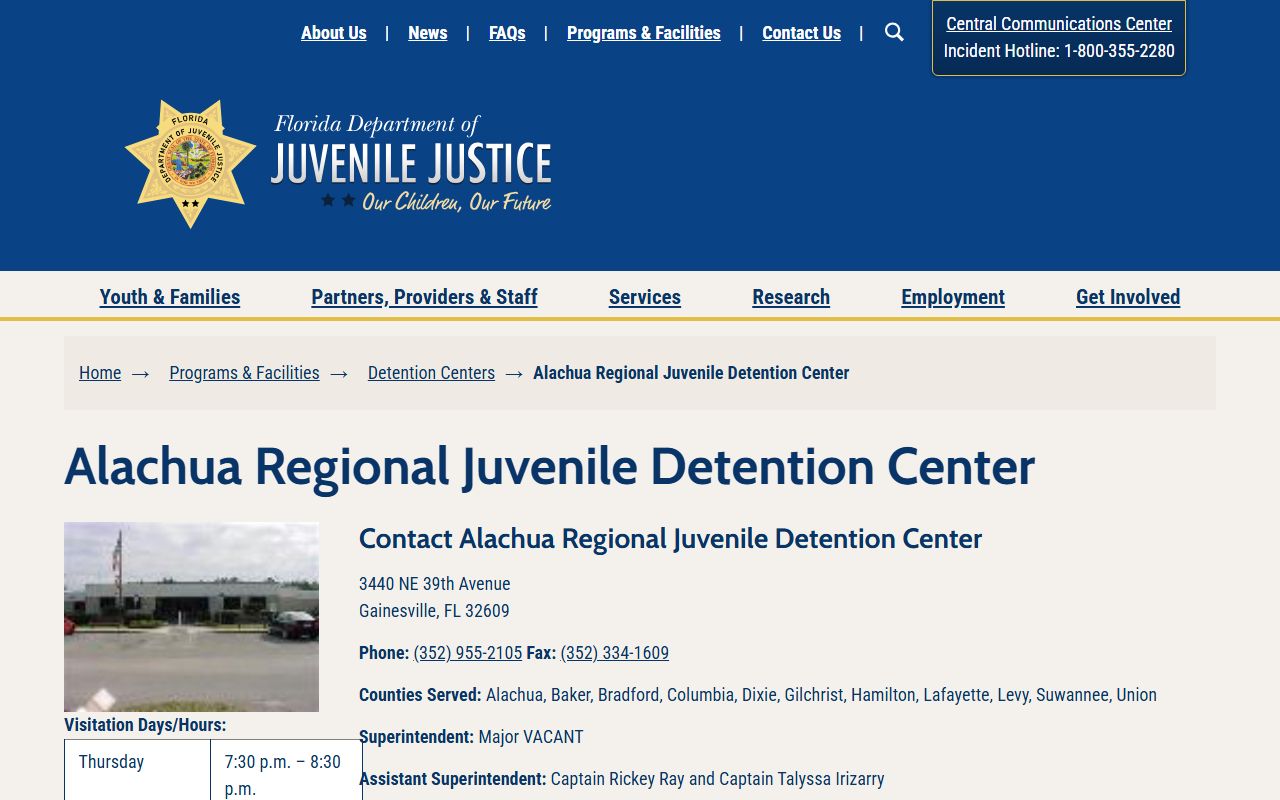
That state page sets out the facility's secure-detention role, the counties it serves, and the visitation rules described below.
Detention Center Address and Contact
The center sits within the cluster of justice facilities along NE 39th Avenue, near the adult county jail but operated separately by the state.
Alachua Regional Juvenile Detention Center
3440 NE 39th Avenue
Gainesville, FL 32609
(352) 955-2105
Florida Department of Juvenile Justice
Visiting a Youth at the Detention Center
Visitation here is limited to a defined set of family members. The state says approved visitors are parents, grandparents, and legal guardians, and that others may visit only by court order or with superintendent approval. Visitors must show photo identification. The published schedule runs on set evening and weekend windows, and it can change around holidays, so confirm before traveling.
| Day | Hours | Type |
|---|---|---|
| Thursday | 7:30pm-8:30pm | In-person |
| Saturday | 2:00pm-3:00pm | In-person |
| Sunday | 2:00pm-3:00pm | In-person |
Note: visitation is limited to parents, grandparents, and legal guardians unless a court order or superintendent approval allows another visitor.
Contact, Programs, and Services
Day-to-day contact and support run through the facility and the state, not a commercial jail vendor. Education, mental health, substance abuse, and health care are provided on site, with medical and mental-health services contracted and schooling funded through local school districts. Families with questions about mail, calls, or items for a detained youth should contact the facility directly, since juvenile rules differ from the adult jail's postcard and kiosk systems.
How Youth Enter Detention
Young people arrive here through the juvenile court process rather than adult booking. A youth may be detained pending adjudication, disposition, or placement in a commitment facility, and the court controls how long that lasts. The short average stay reflects the case-driven nature of detention. Some youth move on to a residential commitment program after a court decision, which is a separate step from secure detention.
Secure Detention vs Residential Commitment
Two different things often get called the same name. Secure detention, the role of this center, is short-term custody while a juvenile case is still being decided. Residential commitment is a longer placement ordered after the court reaches a disposition, and it happens at a separate program such as the nearby Alachua Academy. A youth may pass through detention here and then move to a commitment program, or be released, depending on what the court decides.
The distinction matters for a family trying to locate a young person, because the facility, the rules, and the length of stay differ at each step. Detention is measured in days, while a commitment program runs for a period set by the case plan rather than a fixed sentence.
Counties Served and the Regional Role
This is a regional facility, not a single-county jail. The state lists the counties it serves as Alachua, Baker, Bradford, Columbia, Dixie, Gilchrist, Hamilton, Lafayette, Levy, Suwannee, and Union. Youth detained by the circuit courts across that area can be held here while their cases move forward. That regional draw is one reason the center sits in the cluster of justice facilities along NE 39th Avenue in Gainesville, within reach of the courts it serves. It also means a detained youth may be far from home, so families often coordinate visits and information through the court and the Department of Juvenile Justice.
A Day Inside Secure Detention
The state describes a structured day built around custody and services. A typical schedule includes hygiene, meals, school, structured physical and educational activities, and court appearances as they are set. Education is funded through the Department of Education by way of local school districts, and medical and mental-health services are contracted. Because the average stay is short, around 11 days, the focus stays on safe custody, schooling, and moving each youth to the next court step rather than long-term programming.
Juvenile Records and Confidentiality
Juvenile custody carries privacy protections that adult jail records do not. There is no public juvenile roster, and case information is generally confidential, which is why an online search will not turn up a detained youth the way the adult county roster turns up an adult inmate. Access usually runs through the parent or legal guardian, the youth's attorney, and the Department of Juvenile Justice. For an adult arrested in the same county, the county jail roster and the court system are the right tools, and what happens on the court side after an arrest is covered under court records after a jail arrest.
About the Detention Center
This center is one of several youth and corrections facilities clustered along NE 39th Avenue in Gainesville, which makes the names easy to confuse. It sits near the adult county jail and the nearby Alachua Academy residential program, but each operates under its own rules and population. The detention center's role is secure, short-term custody for youth whose cases are still moving through the juvenile system, with education and treatment built into the daily schedule.
The facility's hardware-secure design reflects that role. It is built to hold youth safely while courts decide each case, not to serve as a long-term placement, which is why the average stay is measured in days rather than months. Families with a young person here should expect to work through the court, the assigned attorney, and the Department of Juvenile Justice rather than an online lookup, and to confirm visiting details directly, since the published evening and weekend windows can shift around holidays and program needs. The center remains separate from the adult jail in every way that matters, from the records rules to the staff and the daily routine.
Note: Confirm visitation eligibility and current hours with the facility before traveling, because juvenile schedules and rules can change around holidays.