
Alachua Academy Overview
The Florida Department of Juvenile Justice lists Alachua Academy as a moderate-risk residential program for female youth ages 12 to 18. It is state-owned and serves Circuit 08, which covers Alachua County and its neighbors. The state describes it as a set of co-located residential commitment programs for girls who need behavioral, mental-health, and substance-abuse services. Unlike secure detention, a commitment program follows a court disposition and focuses on longer-term treatment and supervision.
This is a treatment-centered setting, not a jail. The programs use evidence-based practices to provide care, treatment, and supervision, and schooling is provided through Florida Scholars Academy, which serves juvenile residential commitment programs.
Capacity and Who Is Served
The state lists an operating capacity of 28 for the program. The residents are female youth ages 12 to 18 placed here after a juvenile court disposition, not adults and not pretrial detainees. Because the focus is treatment and reentry into the community, the program centers on counseling, education, and structured daily activity rather than secure confinement.
Services include behavioral and mental-health care, substance-abuse treatment, and education delivered on site.
How to Look Up a Resident at Alachua Academy
There is no public roster for a juvenile commitment program. Florida treats juvenile case and custody information as confidential, so residents do not appear on any searchable public list. For information, families work through the Florida Department of Juvenile Justice, the program, and the youth's attorney. The adult county jail roster and the state corrections locator do not cover juveniles in a commitment program.
- Do not expect a public youth roster; juvenile commitment records are confidential.
- Contact the Florida Department of Juvenile Justice or the program for case-appropriate information.
- Work through the youth's parent or legal guardian and the assigned attorney.
- For an adult in custody nearby, use the county jail roster or the state corrections locator instead.
The state page for the program is shown below.
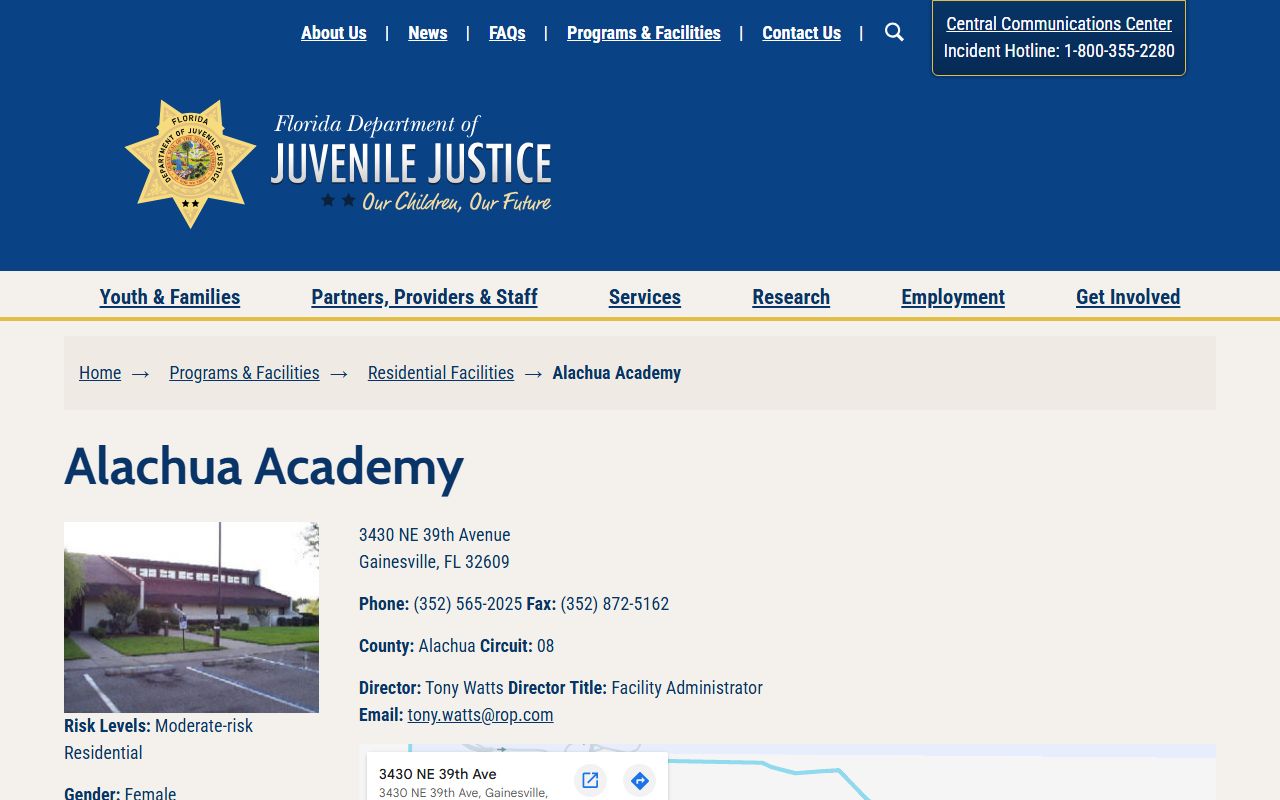
That state page confirms the program's residential commitment role, the youth it serves, and that visitation hours come from the facility.
Alachua Academy Address and Contact
The program sits along NE 39th Avenue near the other juvenile and corrections facilities, but it operates as a state residential commitment program rather than a jail.
Alachua Academy
3430 NE 39th Avenue
Gainesville, FL 32609
(352) 565-2025
Florida Department of Juvenile Justice
Visiting a Resident at Alachua Academy
Visitation at a juvenile commitment program is arranged through the facility rather than a public schedule. The state directs families to contact the program for visitation hours, since residential programs set their own visiting windows around treatment and school. Plan to confirm the day, time, and approved-visitor rules directly with Alachua Academy before traveling.
| Item | Detail |
|---|---|
| Hours | Set by the program; contact the facility |
| Who May Visit | Family and approved visitors under DJJ rules |
| Where to Confirm | Alachua Academy directly at (352) 565-2025 |
Contact, Education, and Services
Mail, calls, and family contact at a residential commitment program are handled through the program, not a commercial jail vendor. Education is provided on site through Florida Scholars Academy, and the program delivers behavioral, mental-health, and substance-abuse services. Families with questions about how to write, call, or send items to a resident should contact the program directly, since juvenile commitment rules differ from both the adult jail and the state prison systems.
How Youth Enter the Program
Girls arrive at Alachua Academy through a juvenile court disposition, not through arrest booking or adult sentencing. After a court commits a youth to a moderate-risk residential program, the placement is treatment-focused and runs for a period set by the case plan rather than a fixed jail sentence. This is the key reason a search for a resident does not belong on any adult roster, and why the program emphasizes care and reentry rather than confinement.
Residential Commitment vs Secure Detention
Alachua Academy is a commitment program, which is a different stage from secure detention. Detention is short-term holding while a case is still pending, often at a center like the nearby Alachua Regional Juvenile Detention Center. A commitment program follows a court disposition and lasts for a period set by the case plan, with the focus on treatment rather than confinement. A girl is placed here after the court has committed her to a moderate-risk program, not while her case is undecided.
That ordering is why no one arrives at the academy straight from an arrest. The court process, including any detention, comes first, and the commitment placement comes after. It also means the right way to track a youth changes as the case moves, so families usually stay in touch with the assigned counselor and attorney rather than looking for an online record.
Education and Treatment at the Academy
The program is built around services rather than custody. Education on site is delivered through Florida Scholars Academy, which provides schooling for juvenile residential commitment programs across the state. Alongside school, the academy provides behavioral and mental-health care and substance-abuse treatment, using evidence-based practices to care for, treat, and supervise girls who need those services.
The state describes Alachua Academy as several co-located residential programs for female youth, so daily life centers on counseling, schooling, and structured activity. Because the operating capacity is small, at 28, the setting is meant to be close and program-focused rather than a large institution.
Juvenile Records and Confidentiality
Records for a committed youth are confidential, and there is no public list to search. Families and attorneys work with the Department of Juvenile Justice and the program directly for information about a resident. This is very different from adult custody in the same county, where the county jail roster shows current adult inmates and the court file follows the charges after an arrest. Anyone trying to locate an adult should use those adult tools, not a juvenile program, and the confidentiality rules here exist to protect the youth rather than to hide information from a parent or guardian.
The NE 39th Avenue Facility Cluster
The academy is part of a tight cluster of justice and youth facilities along NE 39th Avenue in Gainesville, which is exactly why the names get confused. Within a short stretch sit the adult county jail, a state work camp, a state reentry center, and the juvenile detention center, each with its own population and rules. Alachua Academy stands apart as a residential commitment program for female youth, so anyone looking for someone here should confirm they have the right facility before assuming a roster, a visiting schedule, or a phone number applies. The academy is reached at its own line, separate from the others in the corridor.
About Alachua Academy
Alachua Academy is one of several youth and corrections facilities clustered along NE 39th Avenue in Gainesville, near the Alachua Regional Juvenile Detention Center and the adult county jail. Each is a separate system with its own population and rules, which is why the names are easy to mix up. The academy's role is residential treatment for female youth committed by the court, with education and behavioral-health services built into daily life.
The program is state-owned and serves the Eighth Judicial Circuit, which is centered on Alachua County. Its small size, an operating capacity of 28, fits a treatment model that depends on close supervision and steady programming rather than large-scale custody. Because placement here follows a court disposition, the length of stay tracks the case plan, and progress through the program is what shapes the path home. For current visiting hours and approved-visitor rules, the academy itself is the source, since residential programs set those details around school and treatment schedules.
Note: Confirm visitation hours and approved-visitor rules with Alachua Academy before traveling, because residential program schedules are set by the facility and can change.